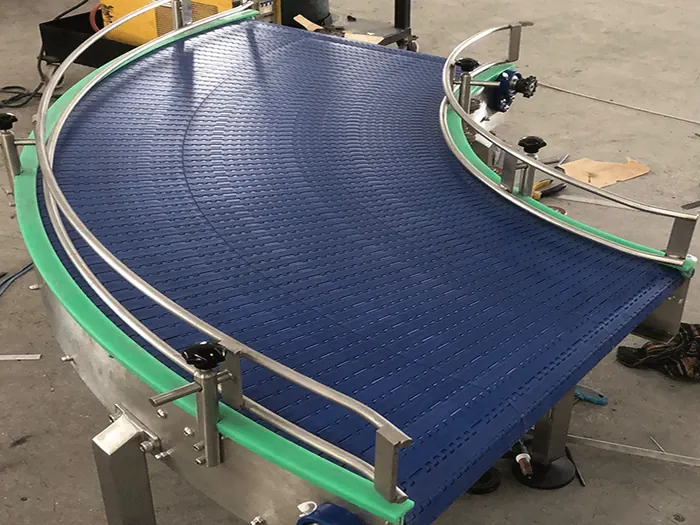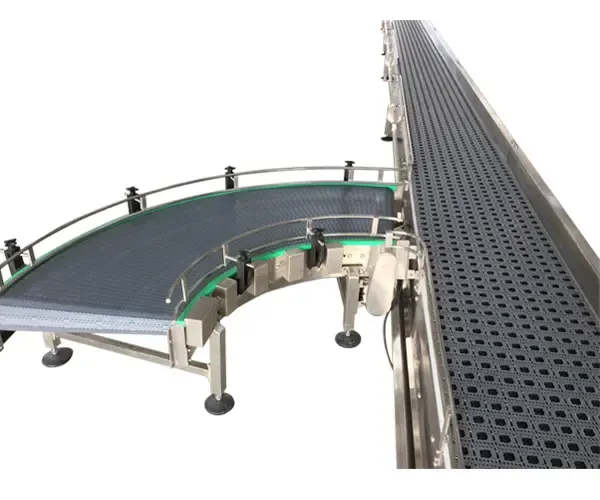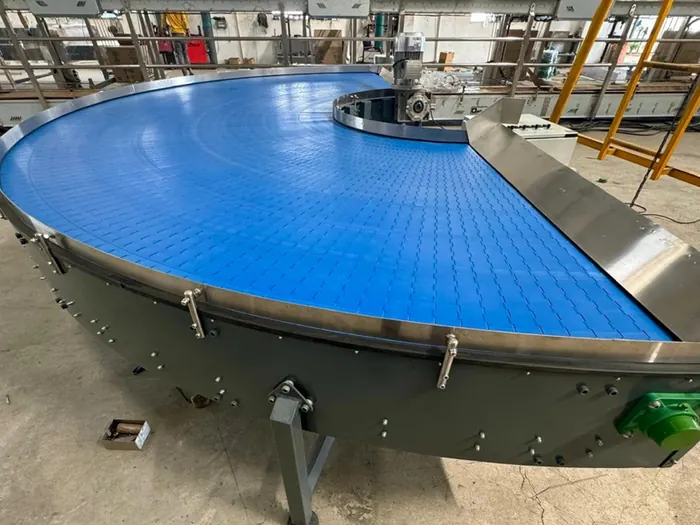
What “zero tangent” means
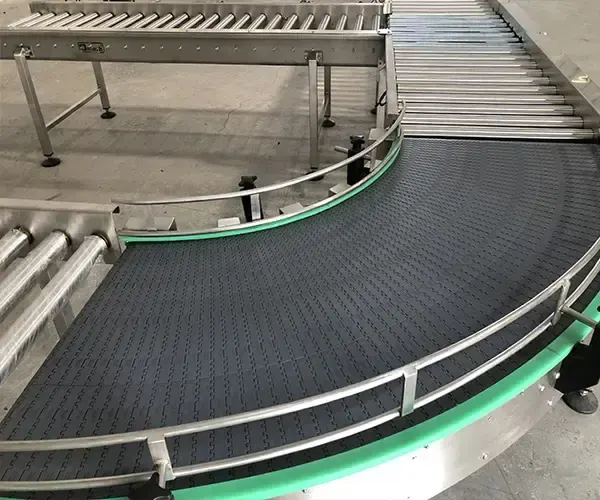
A standard radius belt needs a straight section before and after the curve so the belt can collapse and extend smoothly. A zero tangent radius design removes that straight tangent: the curve starts and ends exactly where it is needed. The result is a much smaller footprint, which is why ZTR conveyors are popular where several lines must fit in a compact hall.
Zero Tangent Radius (ZTR) Conveyor – technical details
| Application | Curve conveyor, width 200 to 1200 mm |
|---|---|
| Usage | Short-space 90° and 180° transfers |
| Load capacity | Maximum 200 kg |
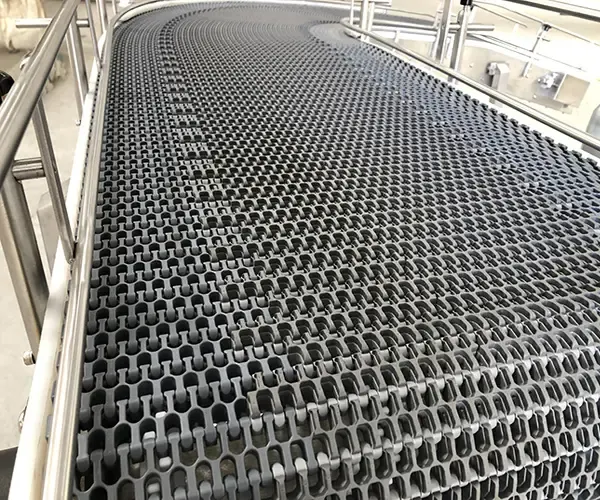
| Belt material | Polypropylene modular belt (grey) |
| Frame | SS 304 or MS powder coated |
| Speed | Up to 22 m/min |
| Side guard | 25 mm to 102 mm as per application |
| Drive | Sprocket on 40 mm solid square shaft |
| Belt styles | Cleated, scoop or flat |
Values are typical; final sizes, speeds and materials are confirmed in the quotation for your application.
Typical uses
- 90° transfers at the end of filling and sealing machines.
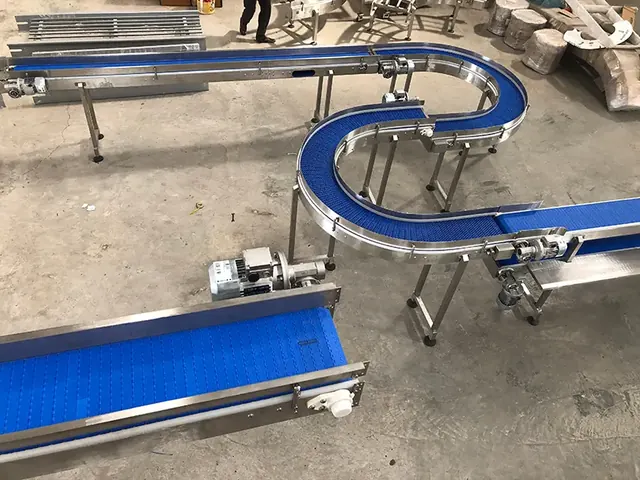
- 180° loops that bring product back to the same operator side.
- Linking parallel lines through tight gaps between machines.
- Combining with ARB modules for merging and transfer.
Construction
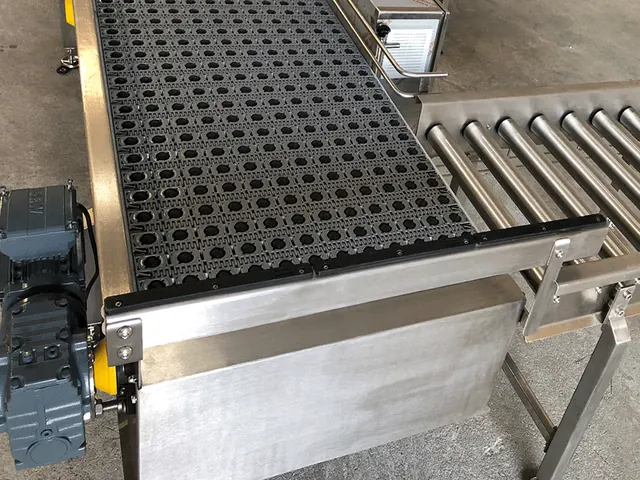
Omtech’s ZTR conveyors use polypropylene modular belts in grey with sprocket drive on a 40 mm solid square shaft. Frames are SS 304 or MS powder coated, side guards are set between 25 mm and 102 mm to suit the product, and cleated, scoop or flat belts are available.
ZTR 90° conveyor
The most common configuration is the zero tangent radius 90 degree conveyor, which replaces a pusher or right-angle transfer with a continuous, gentle curve. For 180° layouts the inside radius is confirmed after reviewing the belt width and product size.
Compare with the curved belt conveyor for wider radii or the helical turning modular belt for compact friction-top transfers.
Applications