
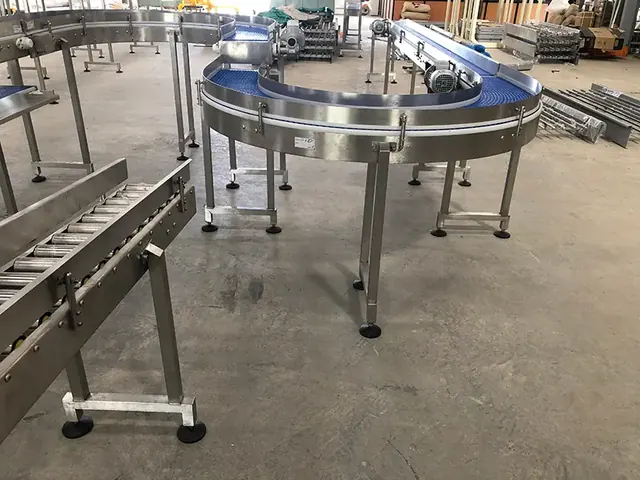
Why hygiene design matters
Most contamination problems on conveyors come from places that are hard to see or reach: hollow frame tubes, flat ledges, belt edges and the underside of the belt. If cleaning crews cannot reach a surface quickly, residue builds up, and microbial risk rises. Hygienic design reduces cleaning time and makes audits simpler, because every surface can be checked.
1. Choose the right belt material
The belt is the main product-contact surface.
- Modular PP or POM belts: suit wet, washed and frozen products; damaged modules can be replaced individually.
- PU belts: smooth and oil resistant; good for bakery, confectionery and fried products.
- Homogeneous / thermodrive belts: no fabric plies, so moisture and bacteria cannot wick into the belt.
- Colour: blue or white belts help operators spot foreign material.
See food conveyor belt materials for a comparison.
2. Keep the frame open and accessible
- Use open channel or round-bar frames instead of closed box sections.
- Slope horizontal surfaces so water drains.
- Avoid unnecessary bolts, threads and crevices in the product zone.
- Leave enough clearance under the conveyor to clean the floor.
SS 304 frames are the usual choice for wash-down areas – see stainless steel belt conveyors.
3. Use easy-clean components
- Quick-release tensioners so belts can be lifted for cleaning.
- Removable wear strips that slide out without tools.
- Sprockets and rollers that can be removed for inspection.
- Drip trays that can be taken out and washed.
4. Plan for inspection and maintenance
Write cleaning into the design brief. Ask how long it takes to remove the belt, where water will drain and how operators will check under the belt. Combine daily visual checks with scheduled inspection of hinge rods, sprockets and wear strips. Replace worn parts early – frayed or cracked belts are both a hygiene and a foreign-body risk.
5. Choose the right conveyor belt supplier
A supplier should ask about your product, cleaning chemicals and audit requirements before recommending a belt. Omtech has built food conveyors since 2007 and designs hygienic conveyor systems around the cleaning routine, not just the product flow.
Quick checklist
| Check | Good practice |
|---|---|
| Belt | Food-grade, suitable for temperature and chemicals |
| Frame | SS 304, open, no hollow sections in product zone |
| Cleaning access | Belt lift or quick release, removable wear strips |
| Drainage | Sloped surfaces, removable drip trays |
| Inspection | Clear sight lines to belt underside and drive |
